


By Ashish Kumar Mandal
In the Terai-Madhesh region of Nepal, a new wave of awareness and discourse has emerged regarding local-level development, social transformation, and good governance. In this context, a broad discussion has begun at the local level concerning the socio-political landscape, historical legacy, and the direction of future leadership in Loharpatti Municipality, Mahottari District.
Education, healthcare, physical infrastructure, and social justice are considered the fundamental pillars for the holistic prosperity of any society. The fact that Dr. Dhirendra Sah—a physician, educational activist, and intellectual—is now a primary subject of discussion as a potential future leader within Loharpatti’s political and social circles serves as an indicator of this transformative consciousness.
Examining the social history of Loharpatti reveals that its development process is not an isolated or accidental occurrence, but rather a continuation of the sense of responsibility and social contributions of its forebears. Dr. Sah’s family background is deeply intertwined with the public life of Loharpatti. His ancestors played a pioneering role in the region by fostering education and uplifting the underprivileged—donating land, establishing schools, and spearheading initiatives for the public good.
This historical family legacy has forged a deep emotional and cultural bond between Dr. Sah and the local community. The tradition of social responsibility initiated by his ancestors appears to have inspired him to transcend personal professional success and dedicate himself to the service of his village and society.
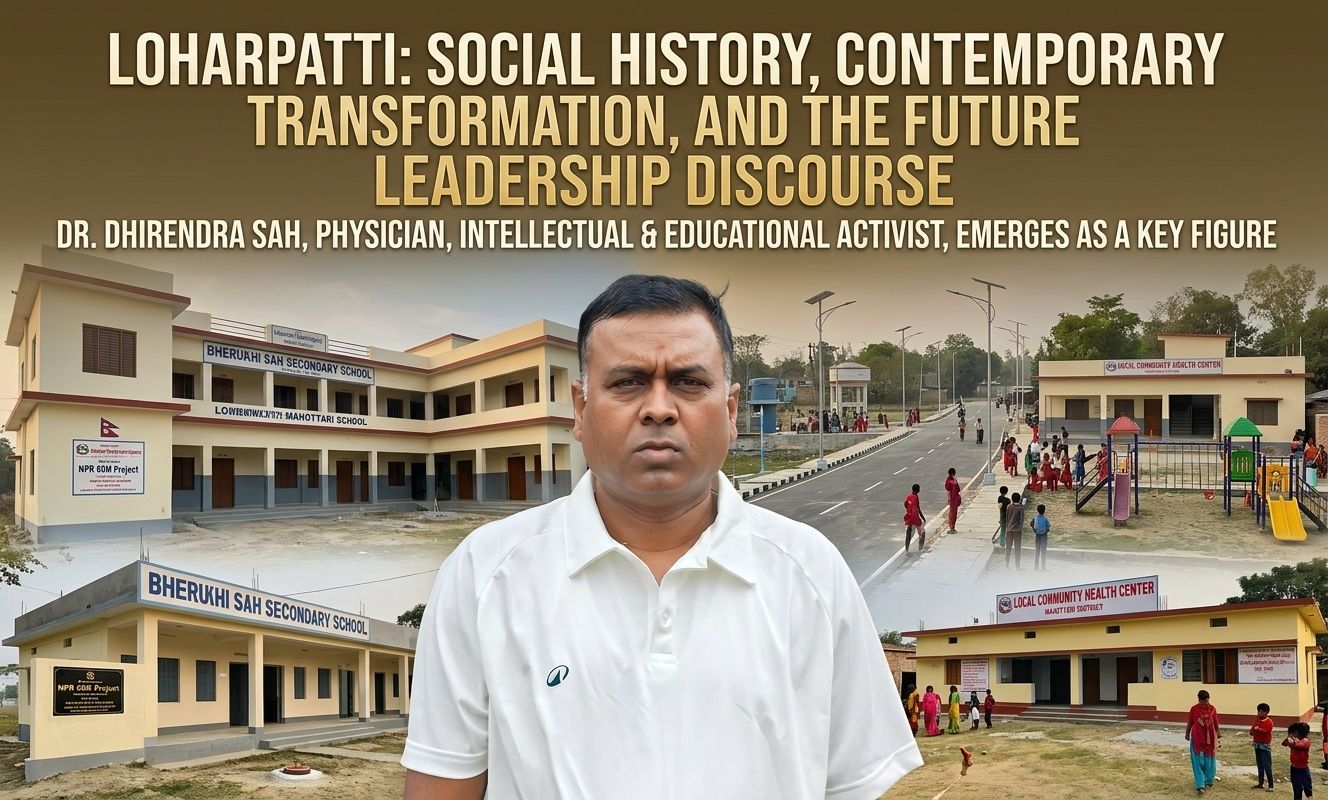
In the present day, Dr. Sah’s public profile and contributions are particularly evident in the modernization of the educational sector and the development of infrastructure. The leadership role played by Dr. Sah as the Chairperson of the School Management Committee at Bherukhi Sah Secondary School has become an exemplary model at the local level.
Thanks to Dr. Sah’s professional competence—demonstrated through consistent coordination with government agencies, the effective navigation of administrative hurdles, and the clear articulation of the school’s needs—a physical infrastructure development project worth approximately 60 million NPR has been approved and is currently underway under a special Government of Nepal program. This initiative, which includes the construction of modern buildings, laboratories, and well-organized classrooms, is fostering an environment where the children of Loharpatti can access quality and affordable education.
Beyond education, Dr. Sah’s active involvement in healthcare and humanitarian efforts is equally significant. As a physician by profession, he has not treated the medical field merely as a source of income; rather, he has utilized it as a powerful instrument for public service and social responsibility.
Recognizing that the rising costs of modern healthcare often leave economically disadvantaged and impoverished families suffering prematurely or deprived of essential medical care, he has consistently facilitated access to free or subsidized treatment. His dedication to providing emergency medical assistance to the underprivileged and promoting health awareness has established him as a trusted figure among the general public.
Transforming Loharpatti Municipality into a modern, prosperous, and well-governed city requires a form of leadership that is distinct from traditional approaches—one that is both capable and visionary. Key priorities for the municipality’s development include expanding access to healthcare, enhancing the quality of education in community schools, ensuring transparency in the selection of development projects, and creating local employment opportunities.
The convergence of Dr. Dhirendra Sah’s professional medical experience, his demonstrated competence in educational management, and his significant family legacy has established him as a strong contender in the discourse surrounding the future leadership of Loharpatti. Nevertheless, when ultimately evaluating potential leaders, citizens are likely to look beyond mere buzz; instead, they will use criteria such as past integrity, future action plans, financial transparency, and a commitment to inclusivity across all communities as the primary benchmarks.
Overall, the presence of Dr. Dhirendra Sah—and the positive discussion surrounding him—is certain to steer the future development and leadership trajectory of Loharpatti in a new and constructive direction.








प्रतिक्रिया