


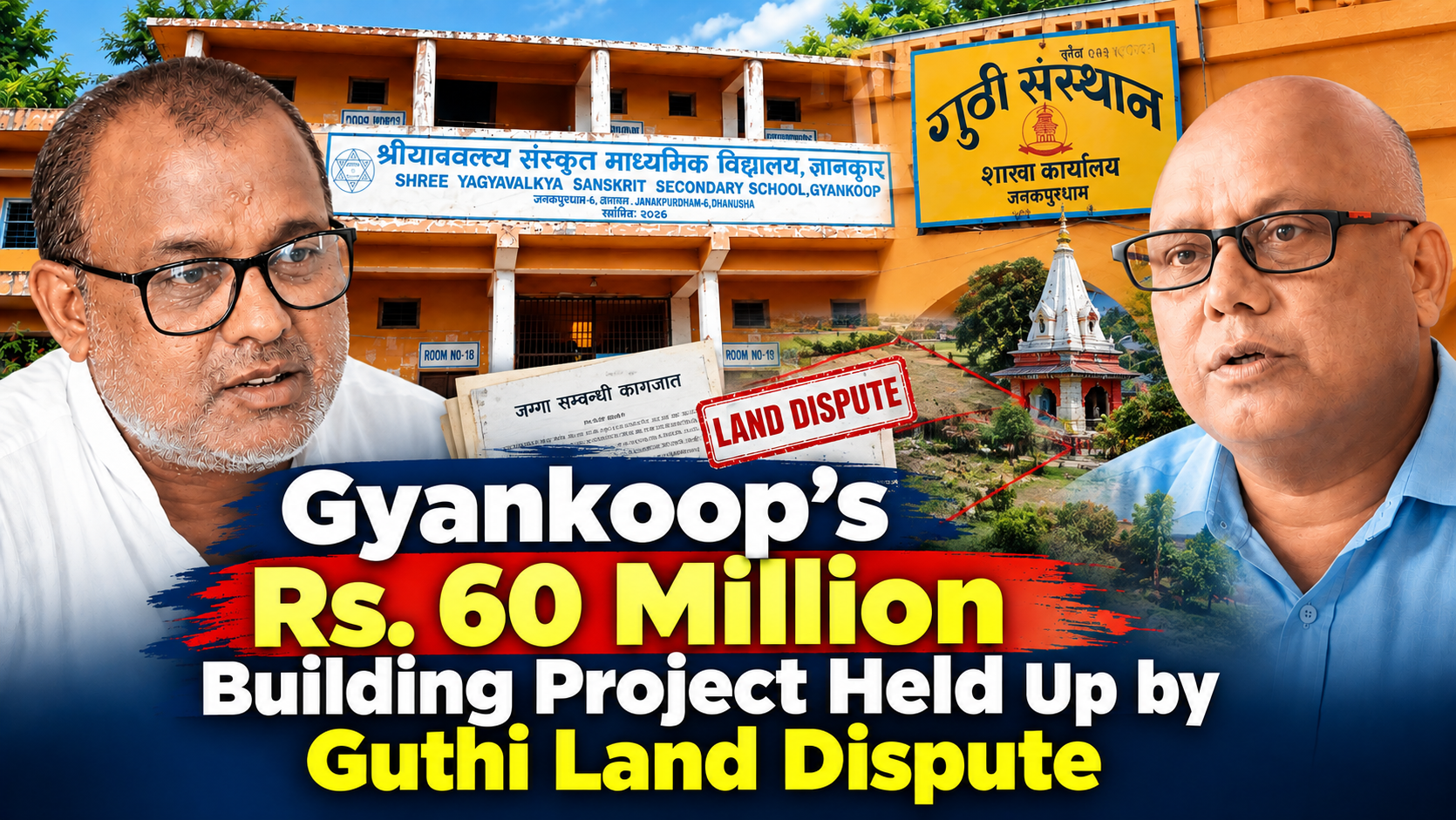
Mayor Manoj Kumar Sah calls for an immediate solution as the school says unclear land records have stalled the tender process
By Ashish Kumar Mandal, janakpurdham, Nepal
The construction of a new building at Janakpurdham’s historic Shree Yajnavalkya Sanskrit Secondary School (Gyankoop) has been thrown into uncertainty despite a budget allocation of around Rs. 60 million, with the school administration citing unresolved issues over the legal status and documentation of the land.
According to the school, the tender process for the building project has been unable to move forward because the required land documents have not been clearly established. The school has warned that if the issue is not resolved within the required timeframe, the allocated budget could remain unused or potentially be returned.
The issue has drawn attention not only to the construction of the school building but also to broader questions surrounding Guthi land records, land ownership documentation, public infrastructure and the implementation of government-funded projects.
The matter also has implications for the educational and residential arrangements of Batuk students studying at the institution.
Janakpurdham Sub-Metropolitan City Mayor Manoj Kumar Sah has expressed concern over the situation and stressed the need for coordination among the concerned government agencies to resolve the land and administrative issues so that the construction project can proceed.
The mayor’s intervention has once again brought into focus long-standing questions surrounding the land used by Gyankoop.
Guthi Land and Development: A Long-Standing Challenge
The uncertainty surrounding Gyankoop’s Rs. 60 million building project has highlighted a wider issue facing development in Janakpurdham: the documentation, management and legal status of Guthi land.
Disputes involving Guthi land, temples, monasteries and public properties in Janakpurdham have existed for years. Public reports and studies have raised concerns over encroachment, incomplete or conflicting records and the management of Guthi properties.
A high-level task force formed in 2062 BS also examined issues involving Guthi properties, monasteries, temples and public ponds in Janakpurdham and submitted a report. Questions over the implementation of its recommendations, however, have continued to be raised.
Guthi properties play an important role in preserving and managing religious and cultural assets and activities associated with them. At the same time, unclear land records, conflicting ownership claims and prolonged administrative procedures can create difficulties for legitimate public infrastructure projects.
The Gyankoop case has brought that tension into sharper focus.
The issue is therefore not simply about the existence of Guthi land, but about whether its records and administration are sufficiently clear, transparent and efficient to protect such properties while allowing legitimate public development to proceed in accordance with the law.
In Janakpurdham, similar questions have surfaced in connection with road expansion, public infrastructure, schools, parks, ponds and other development projects. Public discussions have also focused on alleged encroachment and competing claims involving Guthi properties.
The Guthi Sansthan has also taken steps at various times to document and address allegedly encroached properties. Such efforts have, in some cases, led to disputes with individuals and communities who have occupied or used Guthi land for decades.
This has created a complex institutional challenge: Guthi property requires legal protection, while public development projects require clear and reliable land documentation.
Gyankoop Dispute Raises Wider Questions
The current situation at Gyankoop has brought these broader concerns into the spotlight.
The school administration says it has occupied and used the land for decades. Questions have also been raised over whether the records maintained by the Guthi Sansthan correspond with land revenue records and historical survey documents.
Despite the reported allocation of Rs. 60 million for the construction of the new building, the school says uncertainty over the legal documentation of the construction site has prevented the tender process from moving forward.
The situation raises concerns not only for Gyankoop but also for other development projects in Janakpurdham that depend on clear and legally established land records.
Resolving such disputes may require coordinated action by the Guthi Sansthan, Land Revenue Office, Survey Office, Janakpurdham Sub-Metropolitan City and other relevant agencies.
A coordinated process could include reviewing historical documents, reconciling conflicting records, digitizing land information and establishing the legal status of disputed properties.
The Gyankoop case therefore extends beyond a single school-building project. It highlights the broader challenge of balancing the protection of Guthi property with Janakpurdham’s legitimate infrastructure and development needs.
A clear, transparent and legally grounded mechanism for resolving long-standing land-record disputes could help prevent public projects from being delayed while ensuring that historically and culturally significant Guthi properties remain protected.
For Gyankoop, the immediate question remains whether the land-record issue can be resolved in time for the Rs. 60 million building project to move ahead without further delay.










प्रतिक्रिया