


By Ashish Kumar Mandal, janakpurdham, Nepal
When discussing the Sex Ratio in Nepal, it is essential to understand the difference between overall demographic trends and birth rates. According to the National Population Census 2021 (2078 BS), Nepal’s total population stands at 29,164,578, comprising 14,925,128 females (51.02%) and 14,239,450 males (48.98%). While females outnumber males on the surface, this figure is primarily driven by the large number of men working abroad as foreign migrant laborers and the longer average life expectancy of women.
However, when examining the Sex Ratio at Birth (SRB), an alarming imbalance emerges. While a natural sex ratio at birth of up to 105 boys per 100 girls is considered normal, data from various regions and hospitals across Nepal reveal rates exceeding 110 boys per 100 girls. If this skewed gender ratio at birth continues, future generations will inevitably face severe social crises.
Looking back at history during the eras of kings and world wars, large numbers of men fell on the battlefield, causing a sharp drop in the male population and a higher female ratio. In the modern era, however, without major wars, the drop in female birth rates stems directly from traditional, patriarchal, and narrow-minded societal attitudes.
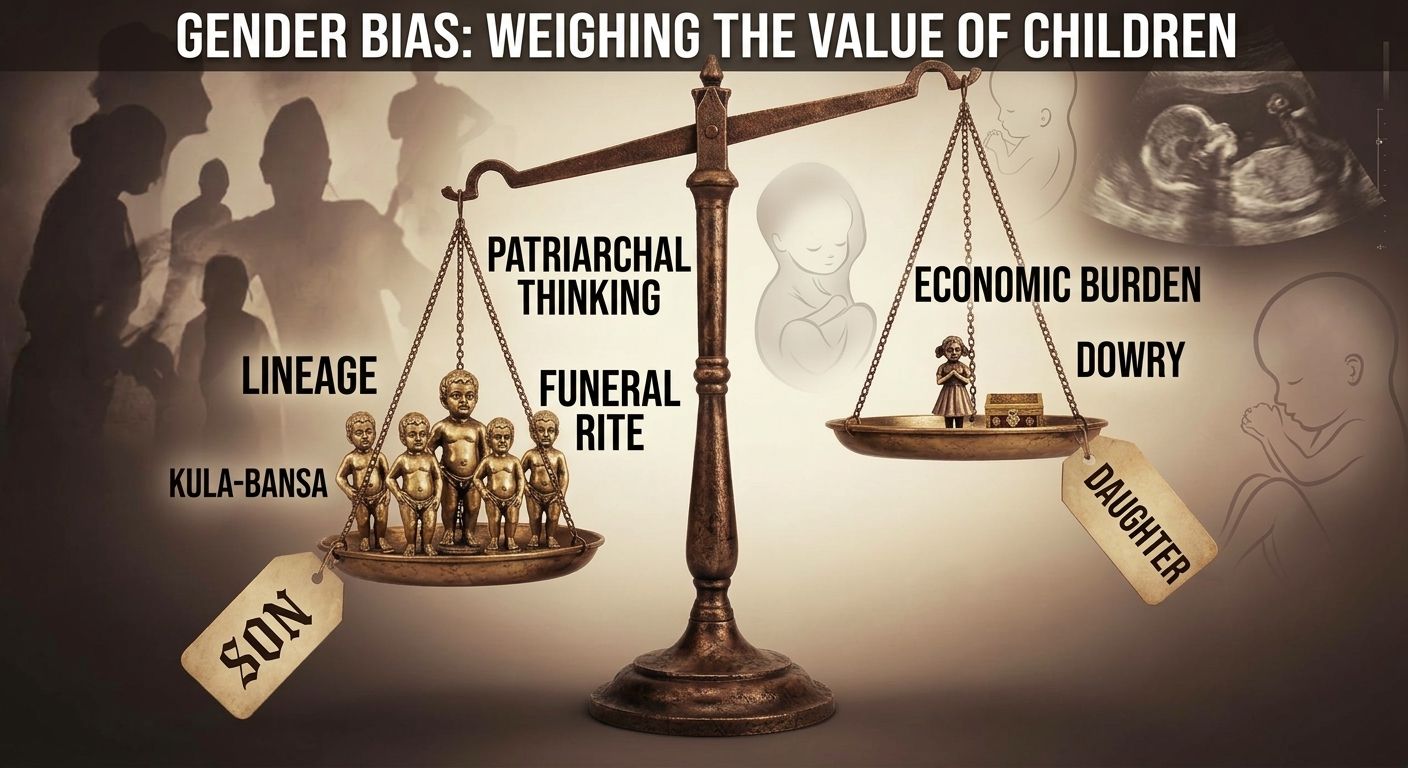
The primary practical factor driving this issue is the fear of the dowry system and its financial burden. Especially across the Terai-Madhesh and urban areas of Nepal, the expectation to provide lakhs in cash, vehicles, jewelry, and household goods at a daughter’s wedding deters many families from having female children. Misguided social perceptions—viewing sons as assets who earn for the family and daughters as liabilities who marry into another household while draining wealth through dowry—lead parents to prefer sons. Furthermore, pervasive societal issues such as rape, sexual violence, and practices like Chhaupadi leave parents perpetually anxious about their daughters’ safety. The practical concern that “raising a daughter is difficult, and any mishap brings societal disgrace” creates an environment of fear around bringing girls into the world.
Concurrently, deep-rooted superstitions persist from an early age—namely, that “a family lineage cannot continue without a son” and “one cannot attain salvation or entry into heaven after death unless a son lights the funeral pyre.” Misinterpretations of religious texts and hypocritical social norms frame sons as ‘saviors’ and daughters as ‘another’s property.’ In reality, spirituality and salvation depend on an individual’s deeds and values, not their gender; however, this understanding has yet to take practical hold in society.
Modern medical technology has further exacerbated these traditional mindsets. With the widespread reach of ultrasound (USG) imaging into rural villages and border areas, illegal sex-selective abortion (female foeticide) persists despite strict laws criminalizing prenatal sex determination and gender-based abortions. Furthermore, rising living costs and busy modern lifestyles have led couples to opt for smaller families of just one or two children. When family size is limited, the mentality of “if we only have one, let it be a son” grows stronger, prompting families to use technology to prevent female births.
The declining female population is already directly impacting marital dynamics and the social fabric. In many villages and towns across Nepal, eligible young men are struggling to find marriage partners, leaving many unable to marry. This shortage of women increases the risk of bride-buying through payment or coercion from remote areas or neighboring countries, heightens human trafficking and legal complications, and exposes women to greater risks of forced marriage, abduction, and sexual crimes.
Therefore, government initiatives like “Save the Daughter, Educate the Daughter” (Beti Bachao, Beti Padhao) must move beyond mere political slogans and paper policies to achieve genuine implementation. Clinics and medical professionals who perform illegal sex determination and selective abortions must face strict legal action. Beyond education, campaigns must focus on making daughters economically independent and completely eradicating the dowry system from society. Until society views a daughter not as a burden, but as an equal partner in the home and nation, this demographic imbalance and social crisis cannot be resolved.










प्रतिक्रिया